
Legacy Media Not Adapting?

Article in Poynter by Tom Rosenstiel, 8/26/26

Headline:  “Opinion | To survive, journalism must become indispensable”

Subhead:  “News organizations need to understand what audiences actually need — and build their journalism around those needs”

“One of the most important and misunderstood reasons for the crisis in journalism has little to do with revenue or technology. The problem is the journalism itself.

“. . .what made newspapers, radio newscasts and TV news programs indispensable to people in the 20th century was not the journalism but what surrounded it. . .

“Today, people find nearly all of that elsewhere. . . .”

Read the full article at:

https://www.poynter.org/commentary/2026/journalism-must-become-indispensable/

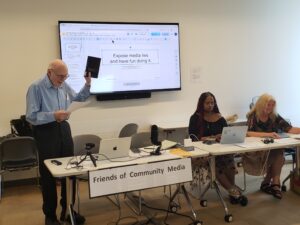
FCM Event Interview on 8/26/26

Friends of Community Media conducted a workshop in August called, “How to expose media lies and have fun doing it.”

You can hear an interview about the event conducted by Spencer Graves on  of Terresa Wilke and Ann Suellentrop exploring the workshop.

You can hear the interview on KHOI community radio in Ames, Iowa at  http://khoifm.org  by scrolling down to Wednesday August 26th – 5 am.

A Case for Print Newspapers


Article in Common Dreams by Russell Mokhiber, 6/10/26

Headline:  “Why Print: On Newspapers, Democracy, and the Things a Screen Cannot Replace”

Subhead:  “We strive for a world in which we are informed with the paper in our hands—a world in which we run with that paper to our elected representatives and demand, ‘What the hell are you doing?'”

“Politics has become strangely empty. We sign petitions with a click, make five-dollar donations with a tap, and mistake engagement for participation.

Capitol Hill Citizen believes that democracy requires something more substantial than that. It requires attention, presence, and involvement. It requires something tangible.

“That is why we print a newspaper.

“In the absence of tangibility, we are each reduced to data, data that corporations use to manipulate us, predict us, and sell us back to ourselves. In a world where corporations are treated as people under the law, Capitol Hill Citizen calls upon its readers to do something that a corporation cannot do: hold a newspaper. Better yet, do democracy. . .”

Read the full article at:

https://www.commondreams.org/opinion/newspapers-better-than-print

Code for Journalists

Article in Columbia Journalism Review by Liz Skalka, 8/10/26

Headline:  “Revising the Ethics Code”

Subhead: “The Society of Professional Journalists is taking a red pencil to its ethics guidelines—the first update since 2014.”

“The Society of Professional Journalists (SPJ), a more than century-old industry organization. . . might be best known for its code of ethics, a set of bullet-pointed precepts that can fit on a poster designed to hang in journalism classrooms and newsrooms: ‘Seek Truth and Report It’; ‘Minimize Harm’; ‘Act Independently’; ‘Be Accountable and Transparent.’ . . .”

Read the full article at:

https://www.cjr.org/feature/society-professional-journalists-spj-revising-the-ethics-code-ethical-precepts-ai-voice-content-creators.php

Progressive Media Growing

Article in Reuters by Helen Coster, 8/6/26

Headline:  “How the new generation of left-wing US media is powering progressive candidates “

“. . .This fast-growing world of left-wing websites, podcasters, YouTube hosts and livestreamers – many of whom blend opinion journalism and activism – affords candidates a sympathetic space to sharpen their message and mobilize grassroots support. But it also risks deepening the fissures in the Democratic Party, analysts say, and alienating moderates in the coalition. . .”

Read the full article at:

https://www.reuters.com/business/media-telecom/how-new-generation-left-wing-us-media-is-powering-progressive-candidates-2026-08-06/

After CECOT – LULAC Begins News

Article in FAIR by Carolina Abbott Galvão. 8/4/26

Headline: ‘The Most Accurate Truth’

Subhead: “After CBS News hit the brakes on a 60 Minutes story about CECOT prison, the League of Latin American Citizens decided it was time to start their own newsroom. Within months, El Grito Media has become a definitive resource.”

“n July 7 in Houston, an Immigration and Customs Enforcement (ICE) agent shot and killed Lorenzo Salgado Araujo, a fifty-two-year-old Mexican man. Audrey Colocho and Katherine Torres of El Grito Media—which this spring started publishing stories directly on Instagram, X, YouTube, and TikTok instead of on a dedicated site—tried to piece together what happened, beginning with a social media post. Soon, they had collected more footage, from more angles—providing a definitive account that became a source for major news outlets. . .”

Read the full article at:

https://www.cjr.org/getting-the-story/the-most-accurate-truth-el-grito-media-ice-salgado-killing-shooting-cecot-el-salvador-venezuela-60-minutes-cbs-news.php

Local Owned Doesn’t Guarantee Local News


Article in Poynter by Jennifer Nehrer, 7/29/26

Headline:  “A community can have local newspapers and still lack local news”

Subhead:  “California’s local news landscape — from a thriving weekly in Carmel to a one-reporter newsroom in Merced — shows why counting newspapers isn’t enough”

“. . .At first glance, California’s local news landscape seems to be thriving. Even the state’s least populous areas compare favorably to some of the United States’ largest regions by one common measure. . .”

“Matt Pearce, director of policy at Rebuild Local News, prefers to add a second statistic to present a fuller picture of who is bringing local news to California communities: the ‘Local Journalist Index,’ a tool that analyzes the number of ‘Local Journalist Equivalents’ in each U.S. county. . .”

Read the full article at:

https://www.poynter.org/reporting-editing/2026/how-to-measure-local-news/

In Crisis, Collaborating Important

Article in Columbia Journalism Review by Irene Romulo and Nina Weingrill, 7/28/26

Headline:  “In a Fast-Moving Crisis, What Is the Role of Journalism?”

Subhead:  “Community news organizations, enmeshed in an information ecosystem on social media and messaging apps, can verify, clarify, and connect.”

“. . .A Media Impact Funders report argues that journalism needs to build infrastructure that is ‘shared, long-term, coordinated, and system-oriented,’ rather than episodic or project-bound. That includes adding coordination roles, offering community training, building trusted networks, and maintaining relationships with community organizations between crises. . .”

Read the full article at:

https://www.cjr.org/analysis/in-a-fast-moving-crisis-what-is-the-role-of-journalism-brazil-flood-venezuela-earthquake-whatsapp-signal-rapid-response-immigration-customs-enforcement-ice-information-sharing-ecosystems.php

Covering a Local Disaster


Article in Poynter by Amaris Castillo, 7/24/26

Headline:  “When the Boundary Waters burned, local journalists answered the call”

Subhead:  “As wildfires spread through one of America’s most cherished wilderness areas, small Minnesota newsrooms became essential for residents and visitors”

“. . .The Boundary Waters Canoe Area Wilderness spans more than 1 million acres of forests, glacial lakes and streams in northeastern Minnesota. It is one of the nation’s most cherished wilderness areas. . .”

“As firefighters battled the blazes in an area that is already hard to access, local journalists mobilized to provide their audiences with up-to-date information. . .”

Read the full article at:

https://www.poynter.org/reporting-editing/2026/boundary-waters-wildfires-local-journalism-minnesota/


Local News is Important

Article in Poynter by Phoenix Chapital, 7/16/25

Headline: “When the World Cup came to Kansas City, local journalists stayed local”

Subhead: “As global media descended on the city, Kansas City reporters found stories only local journalists could tell”

“As international media outlets flocked to Kansas City to cover the World Cup, local journalists responded to the global event by leaning even harder into what they do best: covering their own communities.

“Rather than trying to match the international press corps, Kansas City’s newsrooms found their advantage in telling stories only local journalists could tell. . .”

Read the full article at:

https://www.poynter.org/reporting-editing/2026/local-news-coverage-world-cup-kansas-city/